
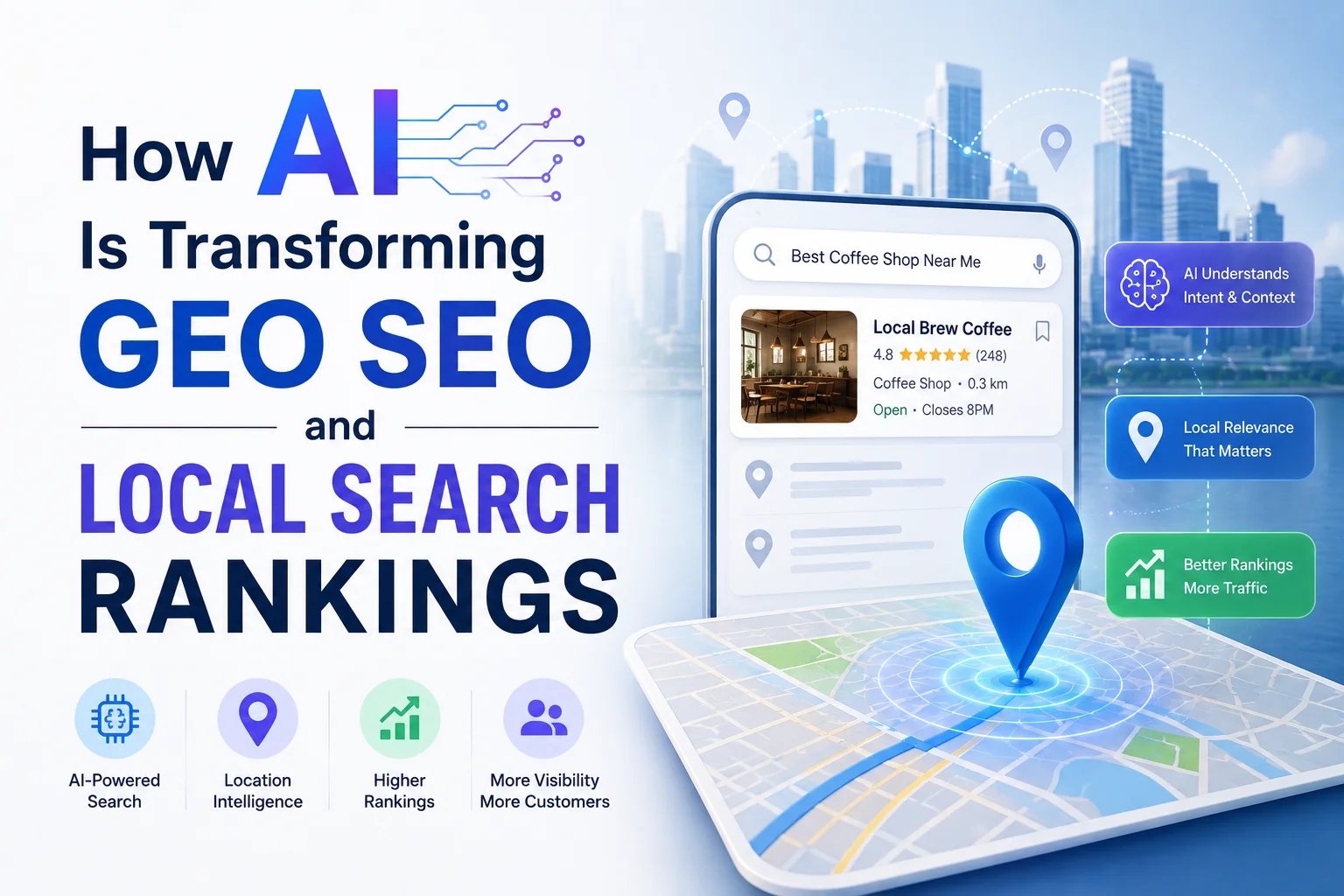
The world of local search is changing rapidly. Traditional SEO strategies that once focused only on keywords and backlinks are now evolving into AI-driven GEO SEO methods. Search engines increasingly use artificial intelligence to understand user intent, location relevance, behavior patterns, and contextual signals.
Businesses that depend on local customers must now adapt to AI-powered local search systems. Whether users search through Google Maps, voice assistants, AI overviews, or personalized recommendations, search engines are becoming smarter in delivering highly localized results.
For businesses aiming to dominate local visibility, working with a Digital Marketing Company in Kochi can help implement advanced GEO SEO strategies and adapt to AI-driven ranking systems.
What Is GEO SEO?
GEO SEO (Geographic Search Engine Optimization) refers to optimizing online presence to rank higher in location-based searches.
Examples include searches like:
- Best restaurants near me
- Ayurvedic clinic in Kochi
- Hotels near airport
- Digital agency nearby
Unlike traditional SEO, GEO SEO prioritizes:
- User location
- Search intent
- Proximity signals
- Google Business Profile relevance
- Reviews and engagement
- Local authority signals
AI now processes all these factors together to determine search rankings.
How AI Is Changing Local Search Results
AI Understands Search Intent Better
Older search systems mainly matched keywords.
Example:
Previous search:
“Coffee shop Kochi”
AI-driven search now understands:
- User location
- Search history
- Time of day
- Device usage
- Preferences
- Review patterns
Google increasingly predicts what users actually need instead of matching exact phrases.
This means businesses must optimize content around intent rather than keyword stuffing.
AI Personalizes Search Results
Local search results are no longer identical for everyone.
Two users searching the same term may receive different results because AI evaluates:
- Previous visits
- Navigation behavior
- Device location
- Reviews read
- User interests
Personalization creates dynamic local SERPs.
Businesses need stronger local signals to appear consistently.
Important factors include:
- Updated business profiles
- Reviews
- Local citations
- Location pages
- Consistent NAP data
AI Is Improving Google Maps Rankings
Google Maps has become one of the biggest local traffic sources.
AI evaluates three major factors:
Relevance
How well a business matches search intent.
Distance
Proximity to the searcher’s location.
Prominence
Authority signals including:
- Reviews
- Citations
- Mentions
- Engagement
AI also analyzes image quality, posting activity, customer responses, and behavioral metrics.
Businesses with active profiles gain stronger visibility.
AI Overviews Are Changing Search Behavior
AI-generated answers are reshaping local discovery.
Users increasingly receive:
- Summarized recommendations
- Local suggestions
- Business comparisons
- Quick answers
Instead of clicking many websites, users interact directly with AI responses.
To appear in these results, businesses need:
Structured Content
Clear headings and semantic formatting help AI understand pages.
Local Entity Optimization
Search engines connect businesses with locations, categories, and services.
Topical Authority
Publishing useful local content improves visibility and trust.
Voice Search and Conversational AI Growth
Voice assistants continue influencing GEO SEO.
Searches now sound like:
- “Where is the best wellness center near me?”
- “What hotel is open nearby?”
- “Find an Ayurvedic clinic around me.”
AI interprets natural language better than exact-match keywords.
Businesses should optimize for:
- Question-based content
- Conversational phrases
- FAQ sections
- Local intent queries
AI Uses Reviews as Ranking Signals
Reviews are more powerful than ever.
AI analyzes:
- Sentiment
- Keywords inside reviews
- Response quality
- Review freshness
- Review frequency
For example, a review mentioning:
“Excellent treatment and friendly staff”
provides stronger contextual relevance.
Encourage customers to leave detailed reviews naturally.
Best Practices for Review Management
- Reply quickly
- Use location relevance
- Maintain consistency
- Encourage authentic feedback
Hyperlocal Content Is Winning
AI rewards local expertise.
Generic pages often struggle to rank.
Businesses should create content around:
- Neighborhood guides
- Area-specific services
- Local events
- City trends
- Community topics
Examples include:
- Best Cafes in Fort Kochi
- Hotels Near Marine Drive
- Wellness Centers in Ernakulam
This creates strong geographic authority and relevance.
AI and Visual Search Impact
Visual search is growing rapidly.
Google Lens and image AI systems now analyze:
- Photos
- Business interiors
- Products
- Location images
Businesses should optimize:
- Image filenames
- ALT text
- Geo-tagged visuals
- Original photography
- Google Business Profile images
High-quality visuals improve engagement and local trust.
Entity SEO Is Becoming Important
AI increasingly ranks entities rather than isolated keywords.
Entities include:
- Business name
- Location
- Services
- Industry
- Reviews
- Brand mentions
Search engines build relationships between these entities.
Businesses should maintain:
- Consistent profiles
- Business directories
- Schema markup
- Social signals
- Location citations
Entity optimization strengthens GEO SEO performance.
Google Business Profile Optimization for AI Search
A complete Google Business Profile remains essential.
Businesses should optimize:
- Business category
- Service list
- Opening hours
- Images
- Products
- FAQs
- Posts
- Reviews
- Attributes
AI continuously scans these elements for relevance.
Regular updates improve local visibility and ranking opportunities.
AI Predictive Search and User Behavior
Search engines now predict user actions.
AI studies:
- Clicks
- Maps direction requests
- Calls
- Time spent on site
- Repeat visits
Engagement patterns influence rankings.
Businesses should focus on:
- Fast-loading websites
- Excellent user experience
- Local landing pages
- Clear calls-to-action
- Mobile optimization
Future of GEO SEO
The future of local search will rely heavily on:
- AI assistants
- Voice search
- Predictive recommendations
- Entity SEO
- Visual search
- Personalized results
- Hyperlocal relevance
Businesses adapting early will gain significant visibility advantages.
SEO is moving beyond keywords toward contextual relevance, user intent, and AI-driven personalization.
Conclusion
AI is reshaping GEO SEO and local search results at an unprecedented speed. Search engines now understand intent, personalize experiences, evaluate reviews intelligently, and prioritize local authority signals.
Businesses must move beyond traditional SEO and embrace AI-driven local optimization strategies to remain visible in competitive local markets.
Partnering with a Digital Marketing Company in Kochi can help businesses build stronger GEO SEO frameworks, improve local rankings, and adapt to evolving AI search systems.
Frequently Asked Questions (FAQs)
Is AI replacing traditional local SEO?
No. AI is not replacing local SEO. Instead, it enhances local SEO by improving how search engines understand intent, relevance, and user behavior.
Does Google Maps use AI?
Yes. Google Maps increasingly relies on AI to rank businesses, personalize recommendations, and improve search accuracy.
Why are reviews important for AI search?
AI analyzes review sentiment, freshness, quality, and context to understand business reputation and customer satisfaction.
What is GEO SEO?
GEO SEO focuses on optimizing a business’s online presence for location-based searches and local audiences.
How can businesses improve local rankings?
Businesses can improve local rankings by optimizing their Google Business Profile, publishing local content, collecting authentic reviews, improving website user experience, and building location authority.

