
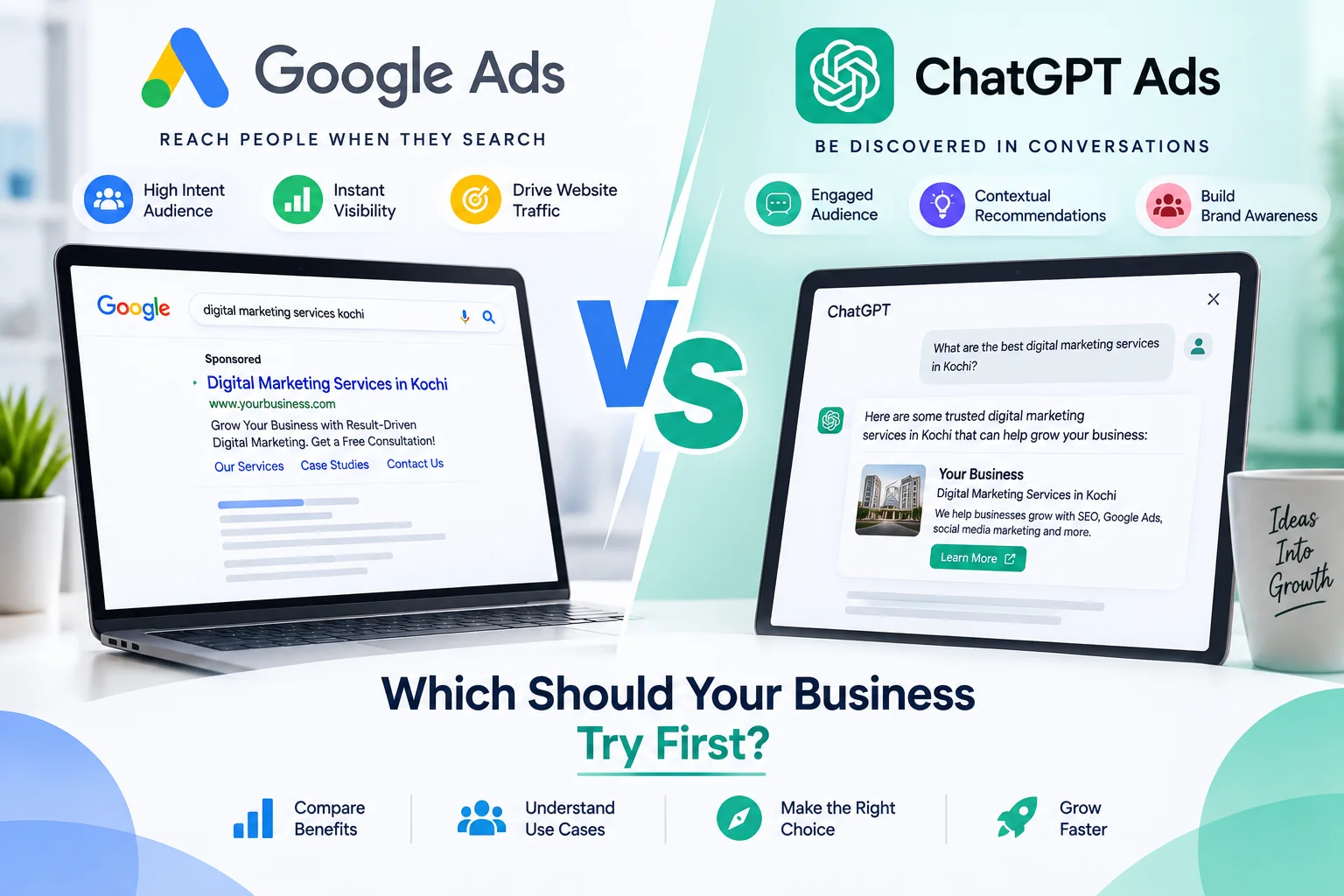
For nearly two decades, Google Ads has been the default starting point for businesses wanting to reach customers actively searching for solutions. But in 2026, that’s no longer the only option. ChatGPT Ads has moved from a quiet pilot to a genuine advertising platform – now live in over 40 countries, including India – and businesses are asking a new question: should we test ChatGPT Ads too, or even instead of Google Ads?
This guide breaks down how both platforms work, where each one excels, and how to decide which one deserves your budget first.
What Is Google Ads?
Google Ads is a pay-per-click (PPC) advertising platform that lets businesses show ads on Google Search, YouTube, and across millions of partner websites through the Google Display Network. It works primarily on keyword targeting and auction-based bidding, showing ads to users at the exact moment they’re searching for something related to your business.
What Is ChatGPT Ads?
ChatGPT Ads is OpenAI’s advertising platform, integrated directly into conversations on the Free and ChatGPT Go tiers. Instead of matching ads to search keywords, ChatGPT ads appear contextually within AI-generated responses – as sponsored answer cards, product spotlight units, or contextual sidebar placements – based on what the user is asking about in real time.
Unlike traditional search, where users click through a list of blue links, ChatGPT delivers a direct conversational answer, with relevant ads woven naturally into that experience.
Key Differences Between Google Ads and ChatGPT Ads
| Factor | Google Ads | ChatGPT Ads |
|---|---|---|
| Ad format | Search text ads, Shopping ads, Display, YouTube | Sponsored answer cards, product spotlights, sidebar placements |
| Targeting basis | Keywords, demographics, intent signals | Conversational context, anonymized signals |
| User experience | Ads shown alongside search results | Ads integrated within AI conversation flow |
| Platform maturity | Established for 20+ years | Newly self-serve since May 2026 |
| Availability in India | Fully mature, widely used | Recently launched, growing |
| Audience visibility | Sees ad-blindness from experienced users | Novel format, currently higher attention |
Where Google Ads Still Wins
1. Proven, Predictable Performance
Google Ads has two decades of data, tools, and optimization features behind it. Businesses can rely on established benchmarks for cost-per-click, conversion rates, and ROI across almost every industry.
2. Massive Reach Across Formats
Between Search, Shopping, Display, and YouTube, Google Ads lets you reach customers at nearly every stage of the buying journey – from awareness to final purchase decision.
3. Strong Local Search Intent
For local businesses in Kochi or anywhere in Kerala, Google Ads remains extremely effective for capturing high-intent searches like “SEO agency near me” or “best restaurant in Kakkanad,” especially when paired with Google Business Profile.
4. Mature Tools and Reporting
Features like Smart Bidding, detailed conversion tracking, and audience segmentation are refined and well-documented, making it easier for businesses and agencies to optimize campaigns with confidence.
Where ChatGPT Ads Have the Advantage
1. Less Competition, For Now
Because ChatGPT Ads only became self-serve in the US in May 2026 and expanded to India and other markets later that year, most businesses haven’t started advertising there yet. Early adopters often benefit from lower competition and potentially lower costs, similar to how early Facebook advertisers benefited before the platform became saturated.
2. Highly Contextual Placement
Ads on ChatGPT are shown based on the actual context of a user’s conversation, which can mean more relevant placement compared to keyword-based targeting alone. A user asking detailed, conversational questions about a product is often further along in their decision-making process.
3. New Behavioral Territory
People increasingly use ChatGPT to research products, compare options, and ask detailed questions before making a purchase – behavior that closely mirrors what used to happen exclusively on Google Search. Businesses that show up in this new “conversational search” journey may capture customers before they even reach Google.
4. Product Feed Integration
For e-commerce brands, ChatGPT’s product feed feature allows an entire product catalog to be uploaded, letting the platform generate ads automatically – reducing the manual work needed to launch and scale campaigns.
Cost Considerations
Google Ads costs vary widely by industry and competition, but businesses generally have a clear sense of average CPCs for their sector after years of available benchmark data.
ChatGPT Ads pricing operates through a relevance-weighted auction, with reported early entry costs in a similar range to competitive Google or Meta campaigns. Because bidding and targeting tools are still evolving, costs and performance benchmarks are less predictable right now – which can be a risk, but also an opportunity for businesses willing to experiment early.
Which Platform Should You Try First?
The right starting point depends on your business goals, budget, and risk tolerance.
Choose Google Ads first if:
- You need predictable, measurable results quickly
- Your customers are actively searching with clear commercial intent (e.g., “buy,” “near me,” “price”)
- You’re a local business relying on location-based search visibility
- You want access to mature reporting and optimization tools
Consider testing ChatGPT Ads if:
- You already have a strong Google Ads foundation and want to diversify
- Your target audience skews toward tech-forward, research-heavy buyers
- You’re an e-commerce brand that can take advantage of product feed automation
- You’re comfortable testing a newer platform with a smaller budget to learn early
A Smarter Approach: Don’t Choose — Sequence
For most businesses, this isn’t really an either/or decision. Google Ads remains the safer, more predictable channel to build your foundation on, especially if you’re new to paid advertising or need immediate, trackable ROI. Once your Google Ads campaigns are stable and profitable, allocating a smaller test budget toward ChatGPT Ads makes sense as a way to diversify your channels and get ahead of a platform that’s likely to grow significantly over the next few years.
Think of it less as “which one” and more as “which one first, and when to add the second.”
Final Thoughts
Google Ads isn’t going anywhere – it remains one of the most reliable ways to reach high-intent customers. But ChatGPT Ads represents a genuinely new advertising surface, and businesses that start experimenting early may build an advantage before the platform becomes as competitive and costly as traditional search advertising eventually did.
If you’re unsure where to start or how to structure a testing budget across both platforms, Zenerom’s Performance Marketing team in Kochi can help you build a strategy that balances proven results with early-mover opportunity.

