
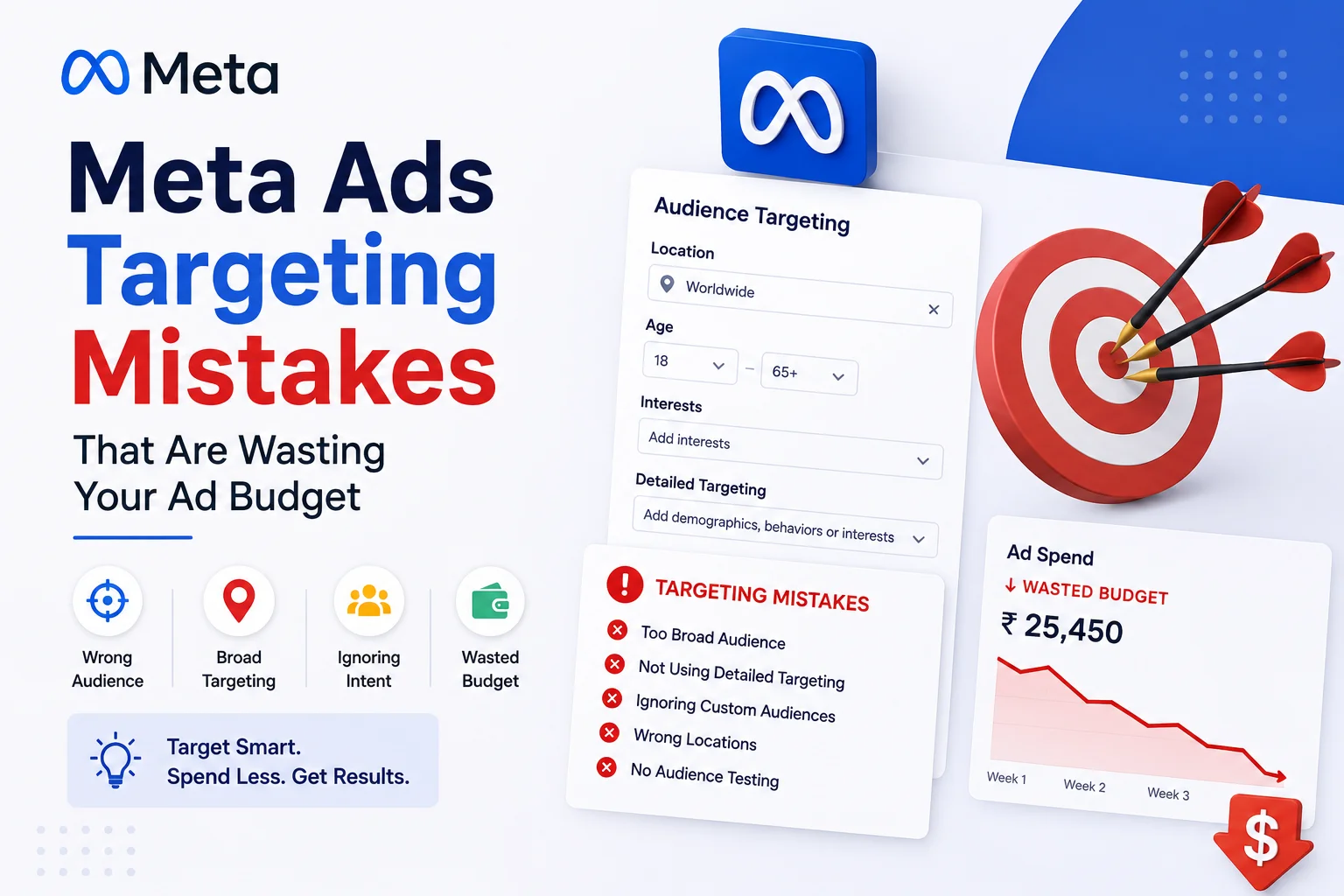
You’ve set up your Facebook and Instagram campaigns, written compelling ad copy, and designed eye-catching creatives – but your cost per result keeps climbing and conversions stay flat. In most cases, the problem isn’t your creative or your offer. It’s your targeting.
Meta’s ad platform gives businesses incredible reach, but it’s also easy to misuse. Small targeting mistakes can quietly drain your budget without you realizing it. Here are the most common Meta Ads targeting mistakes – and exactly how to fix them.
1. Targeting Too Broad an Audience
It’s tempting to think “the more people who see my ad, the better.” In reality, targeting an audience that’s too broad means your budget gets spread across people who have little to no interest in your product, driving up costs without driving real results.
The fix: Start with a well-defined audience based on demographics, interests, and behaviors that closely match your ideal customer. You can always expand later using Meta’s Advantage+ audience expansion once you have performance data to guide it – but don’t start broad and hope the algorithm figures it out.
2. Targeting Too Narrow an Audience
On the flip side, over-narrowing your audience with too many overlapping interest and demographic filters can shrink your reach so much that Meta struggles to deliver ads efficiently. This often leads to high costs per result and slow ad delivery.
The fix: Aim for an audience size Meta itself often recommends – generally in the hundreds of thousands to a few million, depending on your campaign objective and budget. If your audience is too small, Meta’s algorithm doesn’t have enough data to optimize delivery.
3. Ignoring Audience Overlap Between Ad Sets
Running multiple ad sets that target overlapping audiences causes them to compete against each other in Meta’s ad auction. This drives up your own costs and confuses the algorithm about which ad set should get priority.
The fix: Use Meta’s Audience Overlap tool (within Ads Manager) to check for overlap between ad sets before launching. Consolidate similar audiences into a single ad set, or use exclusions to keep them separate.
4. Not Using Exclusions
Many advertisers forget to exclude people who’ve already converted, already purchased, or are current customers from cold acquisition campaigns. This wastes budget showing acquisition ads to people who don’t need them anymore.
The fix: Set up exclusion audiences for:
- Existing customers (via a Customer List or CRM integration)
- People who already completed the desired conversion event
- Website visitors who are already in your remarketing funnel
5. Relying Only on Interest-Based Targeting
Interest-based targeting (targeting people who “like” certain pages or topics) was once the go-to strategy, but Meta’s algorithm has become significantly better at finding converters through behavioral signals and machine learning than through manually selected interests.
The fix: Lean more on Meta’s Advantage+ targeting options and broad targeting paired with strong creative and a well-optimized pixel/Conversions API setup. Let the algorithm’s own signal data do more of the targeting work, especially for businesses with consistent conversion volume.
6. Poor or Incomplete Conversion Tracking
If your Meta Pixel or Conversions API isn’t set up correctly, Meta doesn’t have accurate data to optimize your targeting. This is one of the most damaging – and most overlooked – mistakes, because it silently sabotages every other targeting decision you make.
The fix:
- Verify your Pixel and Conversions API are both firing correctly using Meta’s Events Manager
- Set up server-side tracking via Conversions API to reduce data loss from iOS privacy changes and ad blockers
- Regularly audit your event setup, especially after website changes
7. Not Segmenting by Funnel Stage
Showing the same broad campaign to cold audiences, warm leads, and retargeting audiences all at once wastes spend. Someone who’s never heard of your brand needs a different message – and different targeting – than someone who abandoned their cart yesterday.
The fix: Structure campaigns around the funnel:
- Top of funnel (cold): Broad or lookalike audiences, awareness-focused creative
- Middle of funnel (warm): Website visitors, video viewers, engagement audiences
- Bottom of funnel (retargeting): Cart abandoners, product viewers, past purchasers with tailored offers
8. Ignoring Lookalike Audience Quality
Lookalike audiences are powerful, but only if the source audience is high quality. Building a lookalike from a small, low-value, or outdated customer list often produces poor results.
The fix: Build lookalikes from your highest-value customers (not just anyone who converted once), and refresh your source audiences regularly as your customer base grows.
9. Not Testing Audience Segments Separately
Combining multiple audience types into a single ad set makes it impossible to know which segment is actually performing well and which is dragging down results.
The fix: Test audience segments individually, at least during the learning phase, before combining top performers into consolidated campaigns. Use Meta’s built-in A/B testing tool for cleaner, statistically valid comparisons.
10. Set-and-Forget Campaigns
Audience behavior, ad fatigue, and platform algorithms all shift over time. Businesses that set up targeting once and never revisit it often see performance quietly decline without knowing why.
The fix: Review targeting performance at least every 2–4 weeks. Watch for frequency creep (ads being shown too often to the same people), rising CPMs, and declining click-through rates – all signs it’s time to refresh your audience or creative.
Quick Checklist to Audit Your Meta Ads Targeting
- Audience size is neither too broad nor too narrow
- No significant overlap between ad sets
- Exclusion audiences are set up for converters and existing customers
- Pixel and Conversions API are verified and firing correctly
- Campaigns are segmented by funnel stage
- Lookalike audiences are built from high-value customer segments
- Audience segments were tested individually before scaling
- Targeting and performance are reviewed regularly, not left on autopilot
Final Thoughts
Meta Ads can deliver strong ROI, but only when targeting is built on accurate data, clear audience segmentation, and regular optimization. Most wasted ad spend doesn’t come from bad creative – it comes from targeting decisions made without enough thought or data behind them.
If you’d rather have experts manage strategy, targeting, and optimization for you, Zenerom’s Meta Ads Services team can help you get more conversions from every rupee of ad spend.

