
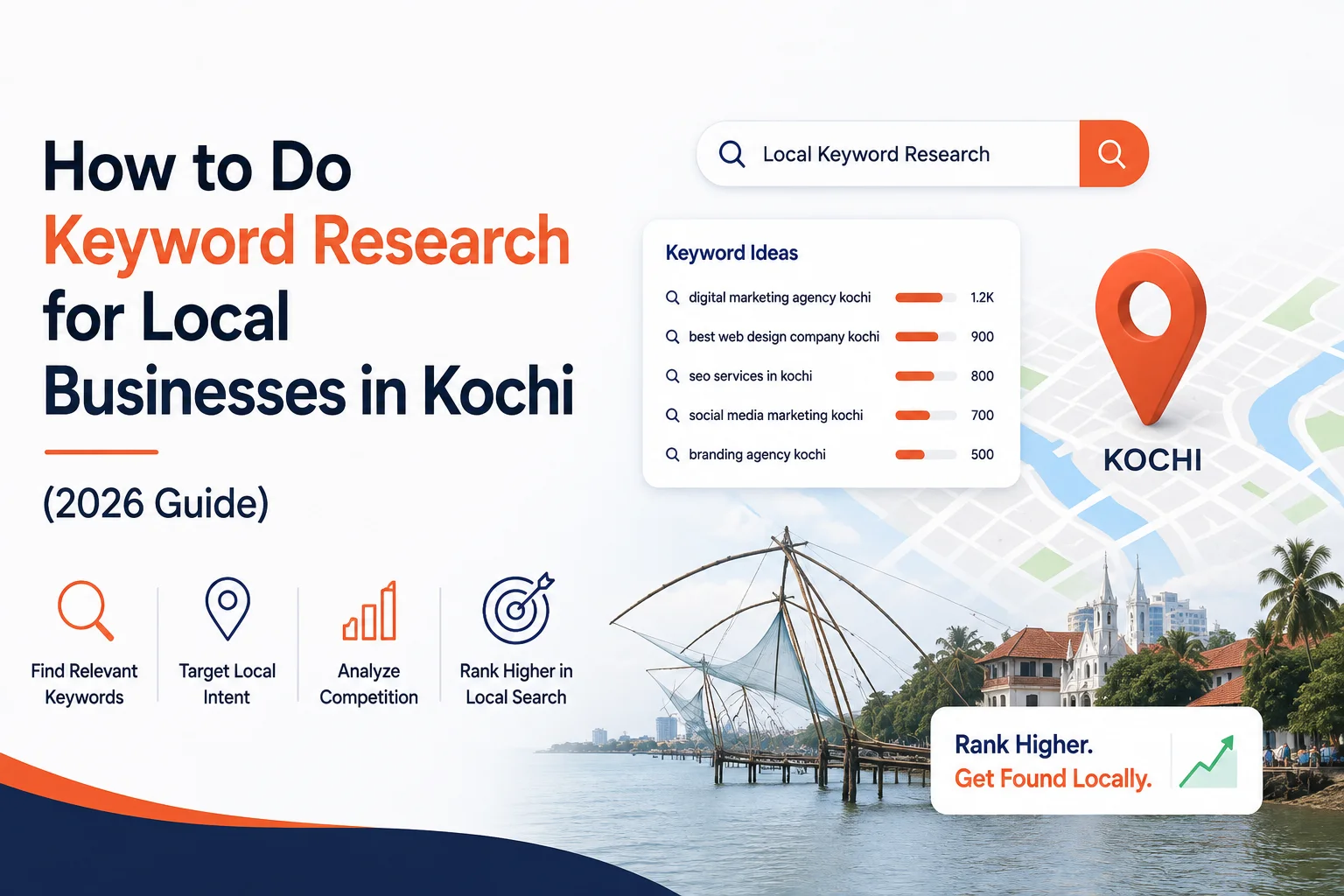
If you run a business in Kochi and your website isn’t showing up when local customers search for your products or services, the problem usually starts with one thing: keyword research.
Most small and medium businesses in Kerala skip this step entirely. They write content based on guesswork – what they think customers are searching for instead of what people are actually typing into Google. The result? Pages that never rank, traffic that never comes, and marketing budgets that go to waste.
This guide breaks down exactly how to do keyword research for a local business in Kochi, step by step, using tools and strategies that work in 2026.
What Is Local Keyword Research (And Why It’s Different)
Local keyword research is the process of finding the exact search terms people in your city or region use when looking for a business like yours. It’s different from general keyword research because it factors in:
- Geographic intent – searches like “near me,” “in Kochi,” or specific neighborhoods (Kakkanad, Edappally, Vyttila, Fort Kochi)
- Local search volume – a keyword might get 10,000 searches nationally but only 50 in Kochi, which changes your priorities
- Voice and mobile search behavior – increasingly common for “near me” and question-based queries
- AI-powered search results – with tools like Google AI Overviews and ChatGPT now influencing how people find local businesses, your keywords need to work for both traditional and AI-driven search
Step 1: Understand Your Customer’s Search Intent
Before opening any keyword tool, list out the real problems your business solves. Ask yourself:
- What does a customer type when they have an urgent need? (e.g., “emergency plumber Kochi”)
- What do they search when they’re comparing options? (e.g., “best interior designers in Kochi”)
- What do they search when they’re just researching? (e.g., “how much does a website cost in Kerala”)
These map to three intent types – transactional, commercial, and informational – and your website needs content for all three, not just “buy now” pages.
Step 2: Build a Seed Keyword List
Start simple. Write down 10–15 core terms related to your services, without location. For example, if you run a digital marketing agency:
- SEO services
- social media marketing
- website design
- branding agency
- performance marketing
These are your seed keywords – the foundation everything else builds on.
Step 3: Add Local Modifiers
Now combine your seed keywords with Kochi-specific modifiers:
- “SEO services in Kochi”
- “digital marketing agency Kochi”
- “website design company Kerala”
- “branding agency near Kakkanad”
- “best SEO company in Ernakulam”
Don’t stop at “Kochi.” Test neighborhood-level modifiers too (Kakkanad, Edappally, Kaloor, Vyttila, Fort Kochi) since hyperlocal searches often have less competition and higher conversion rates.
Step 4: Use the Right Keyword Research Tools
You don’t need an expensive toolkit to get started. Here’s what actually works for local research:
| Tool | Best For |
|---|---|
| Google Keyword Planner | Search volume and local trends by city |
| Google Autocomplete & “People Also Ask” | Real phrases people search for |
| Google Trends | Comparing keyword popularity over time in Kerala |
| Answer the Public | Question-based keyword ideas |
| Ubersuggest / Ahrefs / SEMrush | Competitor keyword gaps and difficulty scores |
| Google Business Profile Insights | What terms actual customers used to find your listing |
Type your seed keyword into Google’s search bar and note what autocomplete suggests — this is real user data, straight from the source.
Step 5: Analyze Keyword Difficulty and Search Volume
Not every keyword is worth chasing. For local businesses, prioritize keywords that are:
- Low to medium difficulty – you’re competing with other Kochi businesses, not the entire country
- Reasonable search volume – even 20–50 monthly searches can be valuable if the intent is strong
- Realistic for your site’s current authority – new websites should target long-tail keywords first before competing for broad terms
A keyword like “SEO” is nearly impossible to rank for. “Affordable SEO services in Kochi for small businesses” is far more achievable and attracts a more qualified visitor.
Step 6: Study Your Local Competitors
Search your target keywords and see who’s ranking. Visit their websites and Google Business Profiles and ask:
- What keywords appear in their page titles and headers?
- What services or blog topics are they covering that you aren’t?
- What are customers saying in their reviews (this often reveals the exact language customers use)?
Tools like Ahrefs or SEMrush can show you the exact keywords a competitor’s page ranks for, giving you a shortcut to keyword ideas you might have missed.
Step 7: Don’t Ignore AI and Answer Engine Optimization (AEO/GEO)
In 2026, keyword research isn’t just about Google’s traditional results anymore. AI tools like ChatGPT, Gemini, and Google’s AI Overviews are increasingly answering local queries directly. To stay visible:
- Target conversational, question-based keywords (“who is the best SEO agency in Kochi for startups”)
- Structure content with clear, direct answers near the top of the page
- Keep your Google Business Profile and citations consistent, since AI tools often pull from structured local data
This is where Generative Engine Optimization (GEO) and Answer Engine Optimization (AEO) come in — worth exploring as a next step once your core keyword strategy is solid.
Step 8: Organize Keywords by Page and Intent
Once you have your list, group keywords by the page they belong to:
- Service pages → transactional keywords (“hire SEO agency Kochi”)
- Blog posts → informational keywords (“how much does SEO cost in Kerala”)
- Location pages → geo-specific keywords (“digital marketing services Kakkanad”)
This prevents keyword cannibalization, where multiple pages compete against each other for the same term.
Common Local Keyword Research Mistakes to Avoid
- Only targeting “Kochi” and ignoring neighborhood-level searches
- Chasing high-volume keywords with no realistic chance of ranking
- Ignoring customer language from reviews and support conversations
- Forgetting to update keyword research as search trends and AI search behavior evolve
- Not aligning keywords with actual page content and search intent
Final Thoughts
Keyword research isn’t a one-time task – it’s an ongoing process that should be revisited every few months, especially as search behavior shifts toward AI-driven results. For local businesses in Kochi, the winning strategy is combining hyperlocal keyword targeting with genuine search intent, backed by consistent content and a strong Google Business Profile.
If you’d rather have experts handle the research, strategy, and execution for you, Zenerom’s SEO Services team in Kochi can help you find and rank for the keywords that actually bring in customers.

