
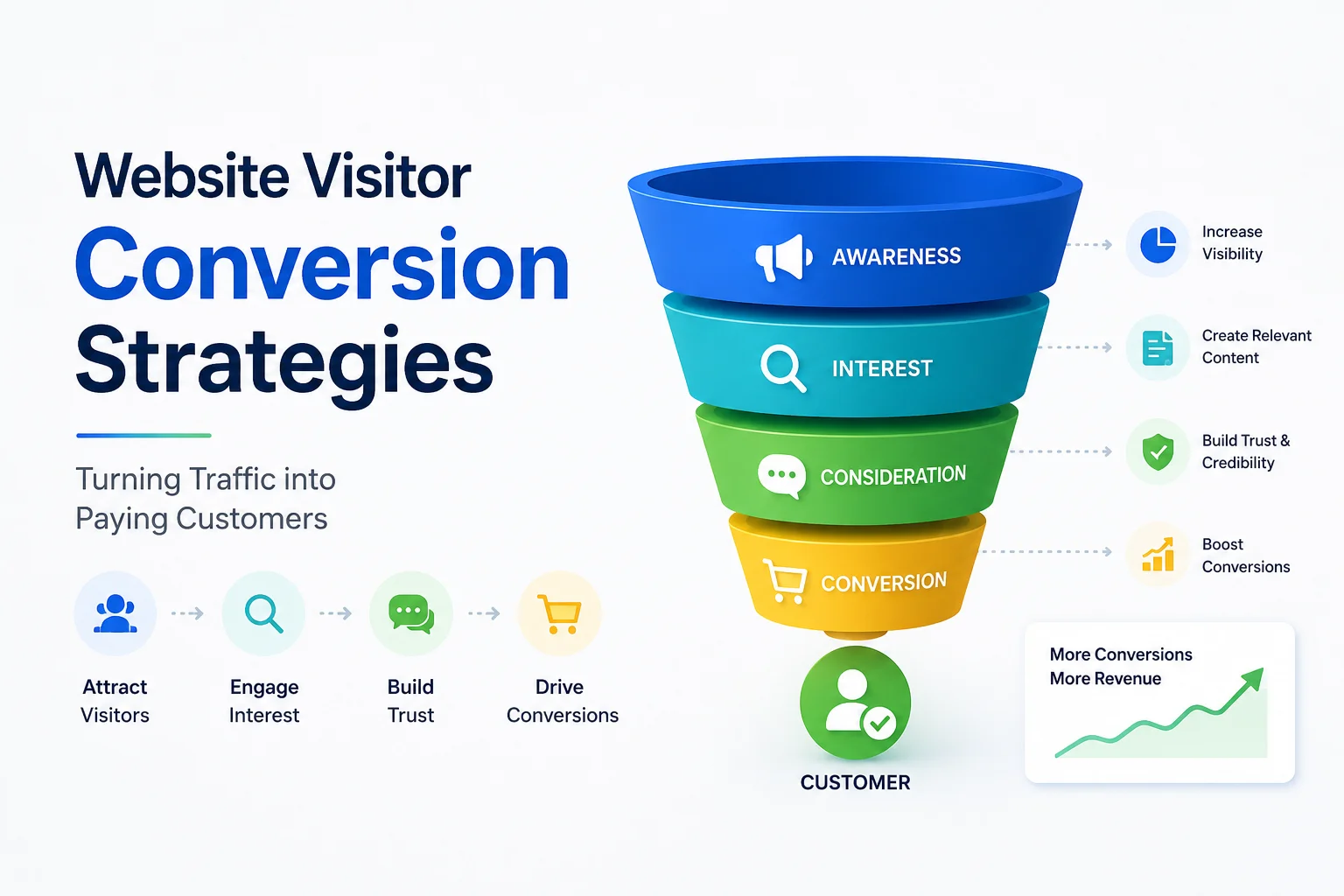
Driving traffic to your website is only half the battle in digital marketing. Many businesses invest heavily in SEO, social media marketing, paid advertising, and content creation to attract visitors. However, attracting visitors alone does not guarantee business growth. The real success lies in converting those visitors into paying customers.
Website conversion optimization is the process of encouraging visitors to take desired actions such as making a purchase, submitting an inquiry, booking a service, or subscribing to a newsletter. A website that receives thousands of visitors but generates few leads or sales is missing significant opportunities.
In today’s competitive online environment, businesses must focus on user experience, trust-building, persuasive content, and strategic marketing techniques to maximize conversions. This guide explores proven strategies that help transform website traffic into loyal customers and sustainable revenue.
Understanding Website Conversion
A website conversion occurs when a visitor completes a specific action that contributes to your business goals. These actions may include:
- Purchasing a product
- Requesting a quote
- Filling out a contact form
- Scheduling a consultation
- Downloading a brochure
- Subscribing to a newsletter
- Registering for an event
Conversion Rate = (Number of Conversions ÷ Total Visitors) × 100
Even a small improvement in conversion rates can significantly increase revenue without requiring additional traffic.
Why Visitors Leave Without Converting
Before improving conversions, it is important to understand why visitors leave.
Common reasons include:
Poor Website Design
Visitors form an opinion about a website within seconds. Outdated layouts, confusing navigation, and cluttered pages create a negative impression.
Slow Loading Speed
Users expect websites to load quickly. Delays often lead to higher bounce rates and lost opportunities.
Lack of Trust
Visitors hesitate to provide personal information or make purchases if they do not trust the website.
Weak Call-to-Action
Without clear instructions, visitors may not know what action to take next.
Complicated User Journey
Long forms, multiple steps, and confusing processes discourage users from completing conversions.
Create a Strong First Impression
First impressions play a crucial role in conversion success.
Use Professional Design
A modern and visually appealing design builds confidence and credibility.
Maintain Brand Consistency
Use consistent colors, fonts, logos, and messaging across all pages.
Focus on User Experience
Simple navigation helps visitors find information quickly and easily.
A clean and organized website encourages users to stay longer and explore further.
Optimize Website Speed
Website speed directly impacts user satisfaction and conversions.
Improve Loading Time By:
- Compressing images
- Using website caching
- Reducing unnecessary scripts
- Choosing reliable hosting
- Optimizing code
Fast websites provide better experiences and improve search engine rankings.
Develop Clear Value Propositions
Visitors should immediately understand:
- What you offer
- How it benefits them
- Why they should choose you
A strong value proposition answers these questions clearly and concisely.
Example
Instead of saying:
“We provide digital marketing services.”
Use:
“We help businesses generate qualified leads and increase revenue through data-driven digital marketing strategies.”
Clear messaging increases engagement and conversion rates.
Build Trust Through Social Proof
People trust recommendations and experiences from others.
Display Customer Reviews
Positive reviews reassure potential customers.
Showcase Testimonials
Authentic testimonials demonstrate real-world success.
Share Case Studies
Case studies provide evidence of measurable results.
Highlight Industry Recognition
Awards, certifications, and partnerships enhance credibility.
Trust signals reduce hesitation and encourage conversions.
Use Effective Call-to-Action Buttons
Every page should guide visitors toward a desired action.
Examples include:
- Get a Free Quote
- Book a Consultation
- Contact Our Team
- Start Your Free Trial
- Download the Guide
CTA Best Practices
- Use action-oriented language
- Make buttons visually prominent
- Position CTAs strategically
- Create urgency when appropriate
Strong calls-to-action improve user engagement and lead generation.
Create High-Converting Landing Pages
Landing pages are designed for specific campaigns and objectives.
Essential Landing Page Elements
Compelling Headline
Capture attention immediately.
Clear Benefits
Focus on customer outcomes rather than features.
Supporting Visuals
Use images and videos that reinforce the message.
Lead Capture Form
Request only essential information.
Strong CTA
Guide visitors toward conversion.
Dedicated landing pages often outperform general website pages because they eliminate distractions.
Improve Mobile User Experience
Mobile devices account for a large percentage of website traffic.
Mobile Optimization Essentials
- Responsive design
- Fast loading pages
- Easy navigation
- Touch-friendly buttons
- Readable text
A seamless mobile experience improves engagement and conversions.
Leverage Content Marketing
Quality content builds authority and nurtures prospects.
Types of High-Converting Content
Educational Blogs
Answer common customer questions.
Guides and E-books
Provide in-depth information.
Videos
Explain products and services visually.
Case Studies
Demonstrate proven results.
FAQs
Address concerns before they become objections.
Valuable content helps visitors move confidently through the buying process.
Utilize Email Marketing for Lead Nurturing
Not all visitors are ready to buy immediately.
Email marketing helps maintain communication until prospects are ready to make decisions.
Effective Email Strategies
- Welcome sequences
- Educational newsletters
- Promotional campaigns
- Customer success stories
- Special offers
Consistent communication keeps your brand top-of-mind.
Personalize User Experiences
Personalization improves engagement by delivering relevant content.
Examples
- Product recommendations
- Personalized emails
- Location-based offers
- Dynamic website content
When users see information tailored to their needs, they are more likely to convert.
Simplify Contact Forms
Long forms create friction.
Best Practices
- Request only necessary information
- Use clear labels
- Minimize required fields
- Enable autofill options
Shorter forms generally produce higher conversion rates.
Incorporate Live Chat Support
Visitors often have questions before making decisions.
Live chat can:
- Answer questions instantly
- Resolve concerns
- Guide visitors through the buying process
- Improve customer satisfaction
Real-time support often increases conversion rates significantly.
Use Strategic Lead Magnets
Lead magnets provide value in exchange for contact information.
Examples include:
- Free consultations
- Industry reports
- Checklists
- Templates
- Webinars
A compelling lead magnet helps grow your prospect database.
Optimize for Search Intent
Understanding visitor intent allows businesses to create content that aligns with customer needs.
Types of Search Intent
Informational
Users seek knowledge.
Navigational
Users look for specific websites.
Commercial
Users compare options.
Transactional
Users are ready to buy.
Content that matches intent typically converts better.
Implement Retargeting Campaigns
Most visitors do not convert during their first visit.
Retargeting helps reconnect with potential customers through:
- Display advertising
- Social media ads
- Email remarketing
Repeated exposure increases brand familiarity and conversion likelihood.
Conduct A/B Testing
A/B testing compares different versions of website elements.
Test:
- Headlines
- CTA buttons
- Images
- Forms
- Landing page layouts
Continuous testing identifies the highest-performing variations.
Analyze Website Data
Data-driven decisions improve conversion performance.
Key metrics include:
- Conversion rate
- Bounce rate
- Average session duration
- Traffic sources
- Exit pages
Analytics tools reveal opportunities for improvement.
Create a Seamless Customer Journey
Visitors should move smoothly from awareness to purchase.
Customer Journey Stages
Awareness
Discovering the brand.
Consideration
Researching solutions.
Decision
Choosing a provider.
Conversion
Taking action.
Retention
Becoming loyal customers.
Each stage requires relevant content and communication.
The Role of Professional Digital Marketing
Many businesses struggle to optimize conversions because they focus solely on traffic generation. Professional digital marketing combines SEO, user experience, content marketing, paid advertising, and conversion rate optimization to maximize results.
Working with the Best Digital Marketing Company in Kochi can help businesses identify conversion barriers, improve user engagement, and develop data-driven strategies that transform website visitors into long-term customers.
Future Trends in Website Conversion Optimization
Businesses should prepare for emerging trends such as:
- AI-powered personalization
- Voice search optimization
- Conversational marketing
- Predictive analytics
- Interactive content
- Advanced customer journey tracking
Companies that adopt these innovations will gain a competitive advantage in customer acquisition and retention.
Conclusion
Website traffic alone does not guarantee business success. The true measure of effectiveness lies in how successfully a website converts visitors into customers. By focusing on user experience, trust-building, compelling content, clear calls-to-action, personalization, and continuous optimization, businesses can significantly improve conversion rates and maximize marketing ROI.
Every visitor represents a potential customer. When businesses implement strategic conversion optimization techniques, they create meaningful customer experiences that drive growth, increase revenue, and build lasting relationships. The key is not simply attracting more visitors but ensuring that every visitor has a clear path toward becoming a loyal customer.

